

Get Ahead of the Chaos: A Smarter Approach to Urgent Care Leadership
Move beyond daily firefighting. Use data, stronger systems, and bench strength to build a more proactive and resilient urgent care operation.

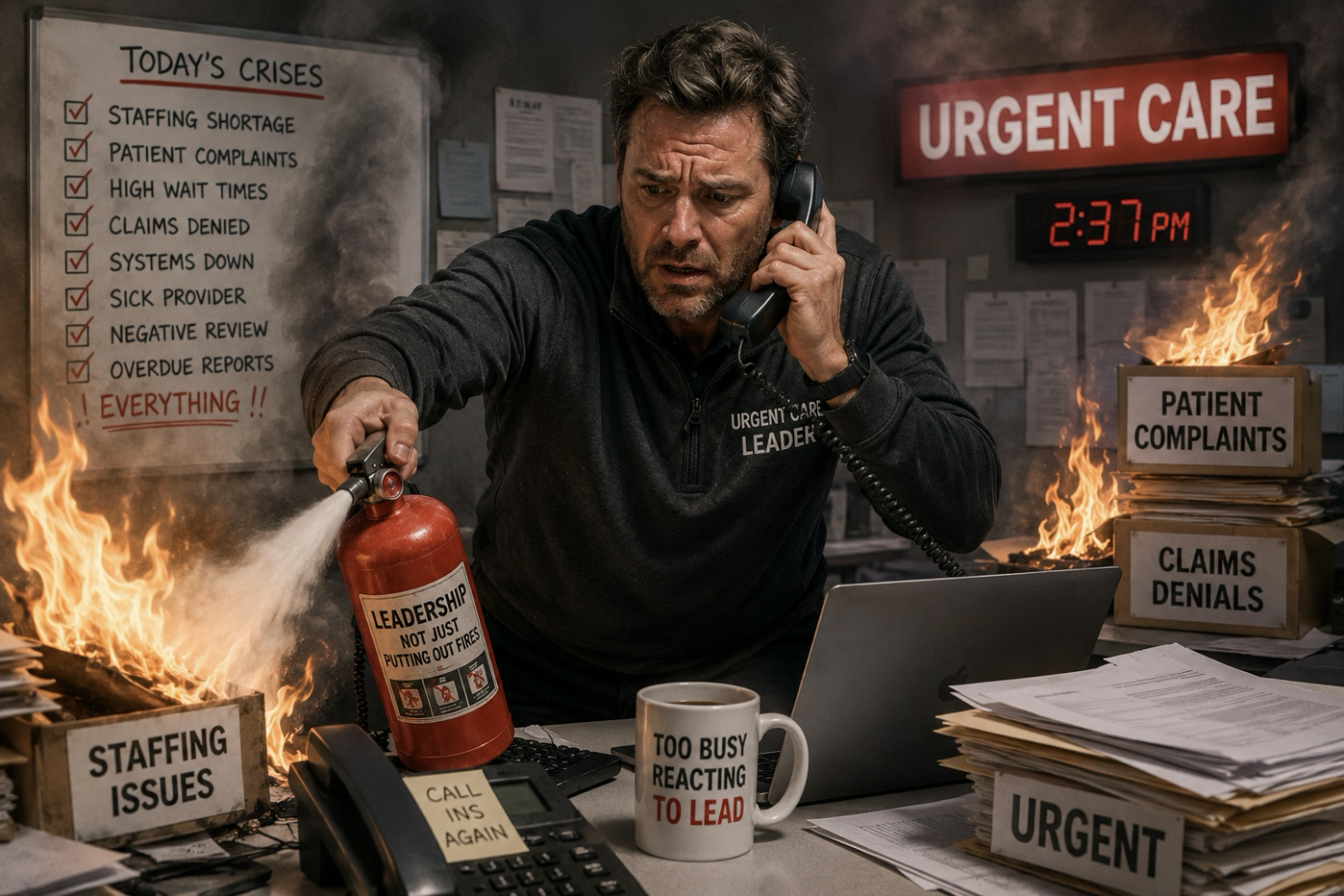
Stop Putting Out Fires: How to Lead Your Urgent Care Forward
If you ask most urgent care leaders how their week has been, you'll often hear the same response:
"Busy."
Busy with staffing issues.
Busy with patient complaints.
Busy with billing questions.
Busy with provider schedules.
Busy solving yesterday's problems.
None of these responsibilities are unusual. Leading an urgent care organization is demanding. Patients don't stop arriving because it's inconvenient. Insurance carriers don't become easier to work with. Staffing challenges don't magically disappear.
The difference between average organizations and exceptional ones isn't that exceptional organizations experience fewer challenges.
It's that effective leaders spend less time reacting to problems and more time anticipating, preventing, and preparing for them.
Leadership Is About Creating Direction
Managers respond to what's happening today. Leaders build systems, people, and strategies that improve tomorrow.
That doesn't mean ignoring day-to-day issues. It means refusing to let today's emergencies consume every ounce of leadership attention.
The most successful urgent care organizations intentionally create time for strategic thinking by asking questions such as:
- What trends are emerging?
- Which problems keep repeating?
- Where are we losing efficiency?
- What can we improve before it becomes a crisis?
- What should we stop doing?
- Who on our team is ready for greater responsibility?
- What does success look like six months or a year from now?
Those conversations rarely happen when every day becomes a race from one emergency to the next.
In many urgent care organizations, the operational leader is just one person—and it's nearly impossible to effectively plan, lead, and grow an organization when that person's attention is constantly being pulled in multiple directions, each requiring immediate problem-solving.
Effective leadership requires creating enough organizational capacity to look beyond today's problems and prepare for tomorrow's opportunities.
Data Should Drive Decisions
If you've been involved in urgent care for any amount of time, you know that most operational problems don't appear overnight.
Patient wait times slowly increase. Provider productivity gradually declines. Charge lag grows. Collection percentages soften. Patient satisfaction trends downward. Staff turnover begins creeping higher.
Each issue starts small and may seem relatively insignificant.
That makes it easy to postpone investigating the underlying cause. Eventually, however, what could have been addressed through early intervention becomes a problem requiring damage control.
Organizations that consistently review meaningful operational metrics can identify trends and potential issues long before they become significant financial, operational, or clinical problems.
Data doesn't replace leadership. It strengthens it.
Instead of making decisions based primarily on assumptions, anecdotes, or the loudest problem of the day, effective leaders rely on objective information to establish priorities and allocate resources where they'll have the greatest impact.
But remember: you cannot manage what you don't measure.
A single data point provides a snapshot. Trends provide intelligence.
Organizations need to consistently collect, measure, compare, and trend their data to understand where they've been, where they are today, and—most importantly—where they're headed.
Build Systems, Not Heroics
Some organizations unknowingly celebrate constant firefighting. Some even build it into job descriptions and workplace culture.
Does your organization have any of these people?
- The administrator who always saves the day.
- The provider who stays late every night.
- The biller who somehow fixes every difficult claim.
- The manager everyone calls because "they're the only one who knows how."
Those efforts deserve appreciation, but they shouldn't become the operating model.
In fact, when an organization depends too heavily on a handful of individuals to keep everything running, that's not necessarily a sign of strength. It may be evidence of operational vulnerability.
Sustainable organizations rely on repeatable processes rather than extraordinary individual effort.
When workflows are documented, responsibilities are clearly defined, knowledge is shared, and expectations are communicated, the organization becomes less dependent on individual heroics and more resilient as a team.
Great leadership creates consistency—not exhaustion.
In an industry where burnout is more than a buzzword, maintaining job satisfaction, professional development, and reasonable balance is far more sustainable than continually rewarding the employee who is forced to go above and beyond just to keep the operation functioning.
Build Bench Strength Before You Need It
One of the most important responsibilities of a leader is developing people who can lead without them.
Ask yourself a difficult question:
If you were unavailable tomorrow, who could step in?
Who could run the morning huddle? Address a staffing issue? Review yesterday's performance? Handle an upset patient? Identify a revenue-cycle problem? Make a sound operational decision without waiting for you?
If the answer to most of those questions is "no one," you don't have a delegation problem—you have a bench-strength problem.
Strong leaders intentionally identify employees with the aptitude, attitude, judgment, and desire to take on greater responsibility. They then give those individuals opportunities to develop before the organization desperately needs them.
That may include:
- Cross-training employees in critical functions.
- Assigning ownership of specific KPIs or operational initiatives.
- Allowing emerging leaders to run meetings or huddles.
- Including them in problem-solving and decision-making discussions.
- Teaching them how to interpret operational and financial data.
- Providing coaching after decisions rather than simply making every decision for them.
- Creating clear career pathways for high-performing team members.
- Developing succession plans for key operational positions.
Delegation isn't simply moving tasks from your desk to someone else's.
Effective delegation transfers both responsibility and appropriate authority.
If a manager is responsible for an outcome but must ask permission for every decision required to achieve it, the leader hasn't truly delegated.
Developing bench strength requires allowing people to make decisions, learn from reasonable mistakes, build confidence, and demonstrate what they're capable of doing.
That can be uncomfortable for leaders who are accustomed to solving every problem themselves. But if everything must flow through one person, that person eventually becomes the organization's biggest bottleneck.
The strongest leader isn't the person everyone needs.
It's the person who has built a team capable of succeeding even when they aren't in the room.
Invest in Your Team Before You Need Them
Leadership isn't demonstrated only during difficult moments. It's developed long before they occur.
Organizations that consistently invest in employee development are better positioned to achieve:
- Higher engagement
- Better retention
- Improved patient experiences
- Greater accountability
- Stronger communication
- More effective delegation
- Internal leadership development
- Better financial and operational outcomes
Training, coaching, mentoring, and regular feedback aren't simply expenses. They're investments that compound over time.
And development shouldn't begin only when you're preparing to promote someone.
Give employees opportunities to stretch while the stakes are manageable. Let them participate in projects. Ask for their ideas. Teach them the why behind operational decisions rather than simply telling them what to do.
A confident, well-prepared team identifies and solves problems earlier, serves patients better, and allows senior leaders to focus on strategy, growth, and organizational performance instead of being pulled into every daily crisis.
Protect Time for Leadership
One of the simplest—and most overlooked—leadership practices is scheduling time to think.
Answering emails, attending meetings, responding to messages, troubleshooting staffing, and addressing immediate operational needs are all necessary. But they can easily become the demand of the day, all day, every day.
When that happens, there's no time left to actually lead.
Forward-thinking activities such as reviewing operational performance, analyzing trends, coaching managers, developing future leaders, evaluating risks, exploring opportunities, and planning improvements repeatedly get rescheduled—or worse, never happen at all.
Leadership rarely happens accidentally.
Leadership that drives sustainable growth requires protected time dedicated to improving the business, not simply operating it.
Put strategic time on the calendar and protect it with the same discipline you would give any other important appointment.
The Goal Isn't Perfection
Unexpected challenges will always arise. That's the nature of healthcare—and particularly urgent care operations.
The goal isn't eliminating every crisis. That's impossible.
The goal is building an organization where fewer issues become crises because the right systems, data, people, processes, and leaders are already in place.
When leaders consistently focus on strategy, communication, accountability, leadership development, and measurable performance, the organization becomes more resilient, more predictable, and better positioned for sustainable growth.
Instead of one person carrying the organization, you develop a team capable of carrying the mission forward.
The clinic stops controlling the leader.
The leader starts guiding the clinic.
Key Takeaways
- Leadership is proactive. Constant reaction isn't a sustainable operating strategy.
- Use data to identify problems early. Trends provide the intelligence needed to act before minor issues become major ones.
- Build systems, not heroics. Your organization shouldn't depend on a handful of people repeatedly saving the day.
- Develop bench strength. Identify and prepare tomorrow's leaders before you need them.
- Delegate authority—not just tasks. Give capable team members ownership and the ability to make appropriate decisions.
- Invest continuously in your people. Training, coaching, cross-training, and mentoring strengthen the entire organization.
- Protect time to lead. Strategic thinking and leadership development deserve scheduled time.
- Measure, adjust, and improve. Strong organizations recognize variation early and course-correct before performance suffers.
What Proactive Urgent Care Leadership Looks Like
What is the difference between managing and leading an urgent care center?
Management focuses primarily on executing daily operations efficiently. Leadership establishes direction, improves systems, develops people, anticipates challenges, and prepares the organization for future success. Strong urgent care operators need both.
Why do urgent care leaders become reactive?
Rapid patient volumes, staffing shortages, payer issues, patient concerns, revenue-cycle challenges, and constant operational demands can consume a leader's time. Without intentionally protecting time for strategic work, immediate issues will almost always take priority.
What metrics should urgent care leaders review regularly?
Important KPIs may include patient wait times, door-to-provider time, length of stay, patient satisfaction, provider productivity, charge lag, first-pass claim acceptance, denial rates, collections, staffing turnover, labor costs, and visit volumes.
The specific KPIs matter, but consistency matters just as much. Leaders should monitor trends rather than evaluating isolated snapshots.
What does "bench strength" mean in urgent care leadership?
Bench strength means having trained, capable employees who are prepared to assume additional responsibilities when needed. It reduces dependence on individual leaders, supports succession planning, improves operational continuity, and creates opportunities for employee advancement.
How can urgent care leaders develop future leaders?
Start by identifying employees who demonstrate good judgment, accountability, initiative, communication skills, and a desire to grow. Give them meaningful responsibilities, expose them to operational decision-making, teach them how to use data, provide regular coaching, and gradually expand their authority as their capabilities develop.
How can leaders become more proactive?
Review performance data consistently, identify trends early, document workflows, develop employees, delegate effectively, establish accountability, and reserve dedicated time each week for strategic planning and leadership development.
How does proactive leadership improve financial performance?
Organizations that identify and address problems earlier are better positioned to reduce inefficiency, control labor costs, minimize claim denials, improve patient retention, strengthen staff engagement, and protect revenue. Over time, operational discipline contributes directly to healthier financial performance.
Closing Thought
At UrgentIQ, we believe operational intelligence is one of the greatest competitive advantages an urgent care organization can have.
But operational intelligence isn't simply having more data. It's having the right information, understanding what it's telling you, developing people capable of acting on it, and creating an organization that can respond intentionally rather than reactively.
That's why we regularly share practical guidance to help urgent care leaders strengthen operations, improve financial performance, develop their teams, and make smarter decisions - so they're prepared before the need arrives.
It's also worth asking whether the organizations you work with are simply vendors or true service-delivery partners invested in your success.
The right partners should engage in frequent, honest conversations about the health of your business; provide meaningful data and analytics to help you understand where your organization stands today; identify potential concerns and opportunities; and help you determine what needs to change to get where you want to go.
If you'd like to learn more about how UrgentIQ's AI-native workflows, analytics, and operational tools can help your team operate more efficiently while giving leaders greater visibility into their business, contact us at Sales@UrgentIQ.com.

More blog posts to read
Prefer to send an email? Send us your request at sales@urgentiq.com, and we'll coordinate with you directly.
