

Urgent Care 2026- Make this the Year to Solve the Biggest Operational Challenges
Smarter urgent care operations for 2026: streamline workflows, tech, and team efficiency.

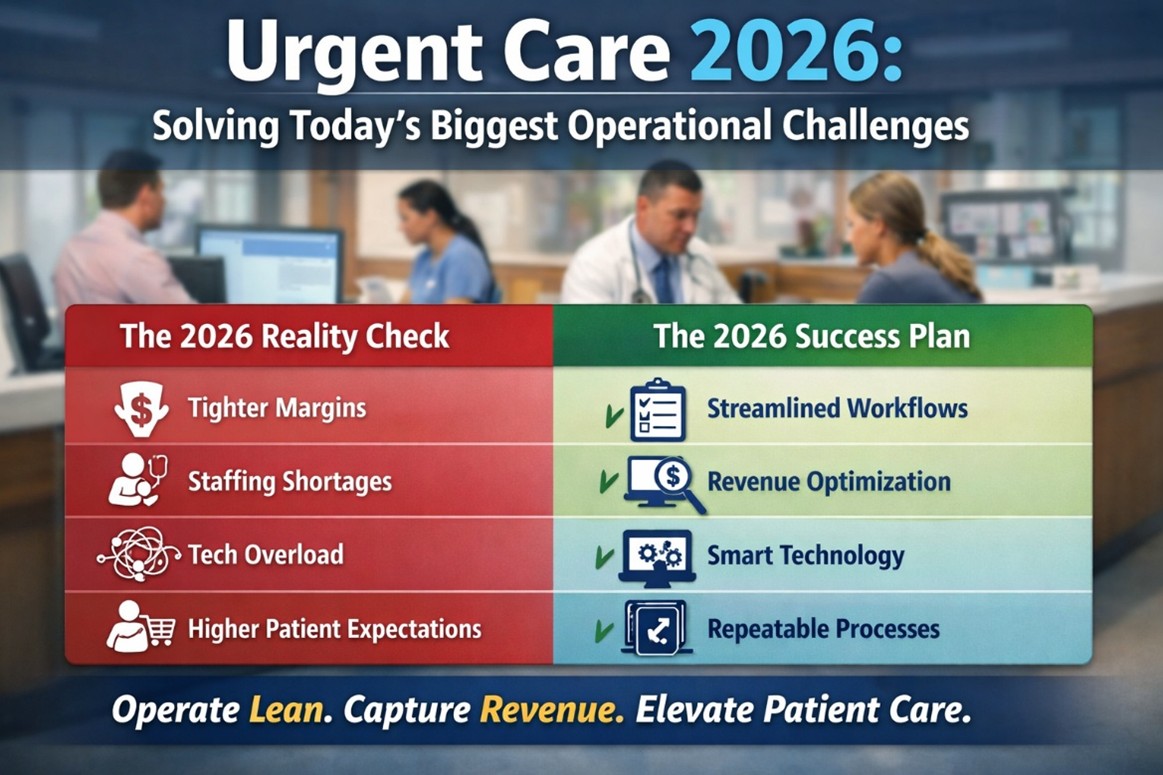
The 2026 Reality Check for Urgent Care Operators
Urgent care was built on speed, access, and efficiency—but the playbook that worked in 2019 or even 2023 is no longer sufficient. In 2026, operators face a convergence of pressures:
- Margin compression from payers
- Workforce instability
- Operational sprawl driven by fragmented technology
- Patients behaving more like consumers than ever before
The good news? These challenges are solvable—with intentional strategy and executional rigor.
The operators who will succeed in 2026 and beyond - are not chasing quick fixes; they are tightening fundamentals, standardizing workflows, leveraging technology with purpose, and holding teams accountable to measurable outcomes. Progress will come not from working harder, but from operating smarter — turning discipline, data, and repeatability into durable competitive advantage.
1. Staffing Shortages: Move from Coverage to Capacity Strategy
The staffing conversation has shifted. It’s no longer about finding clinicians — it’s about maximizing (and retaining) the ones you have.
Winning operators in 2026 will:
- Redesign workflows to reduce non-clinical clicks and documentation burden
- Use standardized templates and automation to compress charting time
- Align provider schedules to actual demand curves—not legacy staffing patterns
Key insight: Every minute saved per chart compounds across thousands of visits annually. Operational leverage beats perpetual recruiting.
2. Reimbursement Pressure: Operational Precision Is the New Margin
Down-coding scrutiny, prior authorization creep, and payer consolidation mean reimbursement is no longer forgiving operational sloppiness.
Centers that protect revenue will:
- Tighten documentation to defensible E&M distributions
- Monitor coding patterns in near-real time
- Eliminate leakage at check-in, eligibility, and patient responsibility collection
- Monitor financials to forecast and pivot when things may be trending negatively
Bottom line: Revenue cycle excellence in 2026 is proactive, not retrospective.
3. Technology Overload: Simplify the Stack, Strengthen the Core
More tools haven’t made urgent care more efficient—they’ve often made it noisier.
Best-in-class operators are consolidating around platforms that:
- Reduce swivel-chair workflows
- Integrate clinical, front-office, and billing functions
- Support automation instead of manual workarounds
Strategic lens: Technology should remove steps, not simply add flash.
4. Patient Experience: Friction Is the New Competitor
Patients now benchmark urgent care against retail, banking, and travel—not other clinics.
2026 expectations include:
- Fast, mobile-first intake – maximized for simplicity and patient convenience
- Transparent pricing and payment options
- Minimal waiting and redundant questioning
Operational truth: Experience failures almost always trace back to internal process gaps—not patient behavior.
5. Data Discipline: From Reports to Real Decisions
Most urgent care centers are data-rich and insight-poor.
High-performing organizations in 2026 will:
- Focus on a short list of operational KPIs that actually drive outcomes
- Review trends weekly—not quarterly
- Use data to inform staffing, hours, service mix, and growth decisions
Execution mindset: If a metric doesn’t change behavior, it doesn’t belong on the dashboard.
6. Growth Without Chaos: Build Repeatable Playbooks
Expansion is back on the table—but sloppy growth is expensive.
Successful operators will standardize:
- Go-live and onboarding processes
- Provider training and clinical templates
- Front-office workflows and payer setup
Result: Each new site launches faster, cleaner, and more profitably than the last.
The Strategic Takeaway for 2026
Urgent care’s next chapter won’t be written by volume alone. It will be defined by operational maturity—the ability to run lean, document smart, deploy technology intentionally, and deliver a consumer-grade experience without burning out staff.
The centers that invest now in tightening workflows, simplifying systems, and aligning teams will not just survive 2026—they’ll set the pace for the decade ahead.
UrgentIQ makes an impact!
In 2026, operational efficiency isn’t a nice-to-have—it’s the difference between scale and struggle. UrgentIQ is built specifically for urgent care operators who need systems that work in real life, not just look good in demos.
Our EMR is robust yet intuitive by design, engineered to reduce clicks, standardize workflows, and support the way urgent care teams actually operate. We don’t ship features for optics—we deploy functionality that measurably improves throughput, documentation quality, front-office efficiency, and revenue capture.
What sets UrgentIQ apart:
· Purpose-built workflows that minimize variation and friction
· Tools designed to save time per visit—not add complexity
· Front-office, clinical, and billing alignment in a single platform
· Continuous refinement driven by real operator feedback
The result: leaner operations, stronger margins, and teams that can focus on patient care—not software.
To learn how UrgentIQ can help your organization operate smarter in 2026 and beyond, contact us at sales@urgentiq.com.

More blog posts to read


Prefer to send an email? Send us your request at sales@urgentiq.com, and we'll coordinate with you directly.
