

Z and W Codes in Urgent Care: When and How to Use them Correctly
Learn when Z and W codes belong on urgent care claims, how to sequence them, and why accurate documentation matters—when the story involves a chicken.

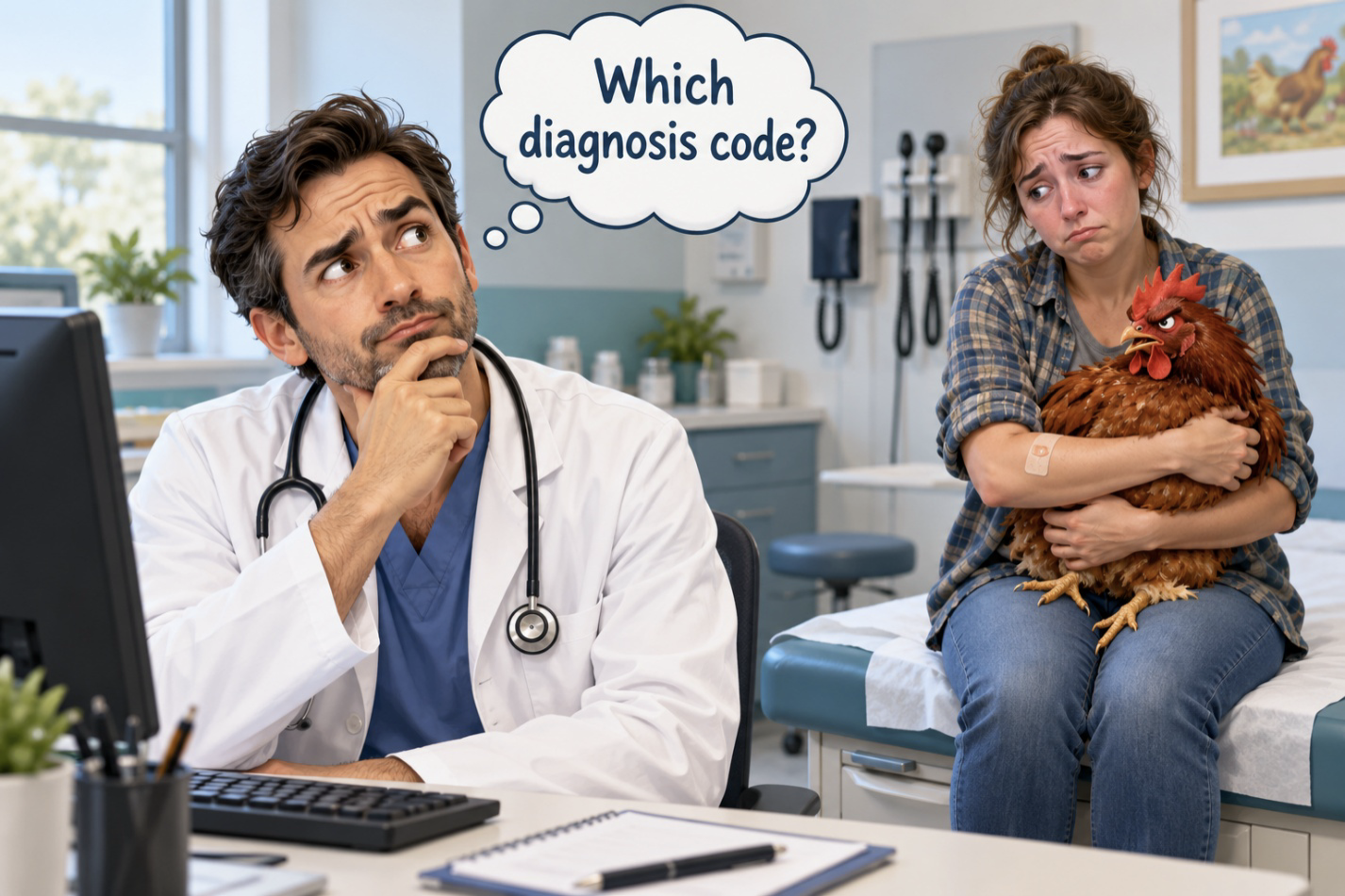
Proper use of Z and W codes that prevent claim denials.
A patient arrives for a screening test. Another needs treatment for a cough. A third comes in with a wound after an unfortunate disagreement with a backyard chicken.
Each encounter tells a different story, and the diagnosis codes should reflect that difference.
Z codes help explain encounter reasons and circumstances influencing care. W codes describe external causes of injuries and other conditions, including falls, contact with objects, and animal encounters. Together with the appropriate condition codes, they can help urgent care teams document a more complete picture of what happened and why care was provided.
Some descriptions might make us smile. Their use on a claim still requires accurate documentation, correct sequencing, and attention to applicable reporting requirements.
What are Z codes?
ICD-10-CM Z codes describe factors influencing health status and contact with health services. They include screening, immunization encounters, personal history, status, and social circumstances. Social determinants of health codes are one subset of the Z code chapter.
A Z code may explain the reason for a visit or supply relevant context, such as a medication allergy that affects treatment. It does not necessarily represent an active disease or injury.
What are W codes?
W codes are part of ICD-10-CM Chapter 20, External Causes of Morbidity. They help describe how an injury or other condition occurred. Examples include a fall, being struck by an object, a dog bite, or being pecked by a chicken.
For an animal injury, the injury code identifies the wound or other condition being treated. The W code describes the animal contact that caused it. Additional external-cause codes may identify the location, activity, or other circumstances when supported and applicable.
An animal-contact W code does not, by itself, describe the wound's location, severity, or treatment.
Can Z or W codes be the primary diagnosis?
For outpatient urgent care, “first-listed diagnosis” is the more precise term.
Z codes may be first-listed or additional diagnoses, depending on the encounter and coding instructions. W external-cause codes can never be first-listed.
Avoid a blanket edit that rejects every claim beginning with Z. Build review rules that reflect the encounter and sequencing requirements instead. For W codes, an edit identifying first-listed placement can catch a clear sequencing problem.
When to use Z codes—and when to reconsider them
A negative diagnostic test does not turn a symptomatic visit into a screening encounter. Likewise, a second appointment does not automatically qualify as follow-up after completed treatment.
In outpatient coding, do not report a suspected condition as confirmed. Report the established symptoms, findings, or other reason for the encounter according to applicable instructions.
When to use W codes in urgent care
Consider W codes when the record describes an applicable external cause of the condition being evaluated or treated. Common urgent care examples include:
- A dog bite resulting in a hand wound.
- A fall resulting in an ankle injury.
- Contact with a sharp object resulting in a laceration.
- An animal strike resulting in a contusion.
Document the mechanism accurately. A patient bitten by an animal and a patient knocked over by that animal may require different external-cause code selections. If an animal causes a fall, review the Index and Tabular List for the documented sequence of events rather than assuming a direct-contact code captures the entire incident.
External-cause reporting is not nationally mandatory in every encounter. State mandates and individual payer requirements may apply. Where reporting is not required, the official guidelines encourage voluntary reporting because the information supports injury research and prevention.
Build a payer and state reference for your clinic so staff understand when these codes are required.
Animal encounters: amusing descriptions, meaningful documentation
ICD-10-CM includes remarkably specific animal-contact codes. These examples all specify initial encounter; the captions are humor, not coding definitions.
These are W codes, not Z codes. Use the specific code only when the documented event supports it, and report the condition being treated first.
Everyday life has Z codes, too
Z code descriptions can also feel surprisingly familiar:
The relatable descriptions make useful training conversation starters. They should not become automatic claim selections based on a casual comment or a joke. Report documented, relevant circumstances according to the code's instructions.
How Z and W codes can appear in the same encounter
Consider a patient receiving active treatment for a dog-bite wound. The clinician also documents a medication allergy that affects antibiotic selection.
The diagnosis set may include:
- The appropriate injury code, specifying the site, laterality, wound characteristics, and encounter character as applicable.
- W54.0XXA, bitten by dog, initial encounter, as an additional external-cause code when reported.
- The appropriate allergy-status Z code when documented and relevant.
The injury explains what is being treated. The W code explains how it happened. The Z code explains a circumstance influencing care. Follow applicable sequencing instructions for the complete diagnosis set.
If a vaccine or another separately reported service is provided, select and link the diagnosis appropriate to that service and encounter. Do not assume every service should point to the same diagnosis simply because it appears on the same claim.
“Initial encounter” does not simply mean the first visit
For injury and external-cause codes requiring encounter characters, the character reflects the phase of care.
- A—Initial encounter: Active treatment, which may occur at more than one visit or with more than one provider.
- D—Subsequent encounter: Routine care during healing or recovery after active treatment is completed.
- S—Sequela: A residual effect after the acute phase has ended; follow the applicable sequencing rules.
Use the external-cause encounter character that corresponds to the phase of care for the condition. Do not automatically change A to D because the patient has already been seen elsewhere.
Will Z or W codes help a claim get paid?
Accurate coding and benefit coverage are separate decisions. A valid Z code does not guarantee coverage, and adding a W code does not automatically establish medical necessity or increase reimbursement.
Ask three questions before submission:
- Does the diagnosis set accurately represent the documented encounter?
- Does each service-line diagnosis pointer connect the service to the appropriate reason it was provided?
- Does the patient's plan cover the service under the documented circumstances?
A claim may pass submission edits and still be denied during adjudication. If a correctly coded service is denied, review the denial and applicable policy before changing the claim. Any correction must remain supported by the record.
Seven steps to improve Z and W code claim submission
1. Document the encounter's purpose. Clearly identify why the patient came in, what was evaluated, and what care was provided.
2. Capture injury details. Document the site, laterality, mechanism, animal or object involved, and phase of care when relevant. Include location and activity details when known and needed for applicable reporting.
3. Review sequencing. Confirm the first-listed diagnosis reflects the encounter and coding instructions. Never place a W external-cause code first.
4. Review additional diagnoses. Include supported Z codes and applicable external-cause codes. Avoid unrelated carryover diagnoses and unsupported assumptions.
5. Check service-line diagnosis pointers. Link procedures, tests, vaccines, and other services to the appropriate diagnoses. A correct code elsewhere on the claim may not resolve a mismatched pointer.
6. Validate codes and reporting requirements. Use the ICD-10-CM release applicable to the date of service, complete reportable codes, required placeholders, and appropriate encounter characters. Review state and payer external-cause requirements separately from coverage policies.
7. Turn denials into workflow improvements. Ask your billing team or third-party vendor to distinguish invalid codes, sequencing errors, missing required external-cause information, pointer issues, and benefit exclusions. Review recurring problems with providers and intake staff.
Frequently asked questions - RECAP
Are Z codes only secondary diagnoses? No. Their placement depends on the encounter and applicable instructions.
Can a W code be first-listed? No. External-cause codes can never be first-listed.
Are W codes required on every injury claim? There is no national requirement for universal external-cause reporting. Check applicable state mandates and payer requirements.
Does adding a Z or W code increase the E/M level? There is no automatic increase. Select the E/M service using the applicable requirements and encounter documentation.
Should every Z code in the chart appear on the claim? Avoid automatic copying. Review relevance, documentation, and reporting instructions.
What should we do when a payer rejects one of these codes? Identify the actual error, validate the code and sequencing, check diagnosis pointers and requirements, and correct supported errors. Do not substitute an unsupported diagnosis simply to clear an edit.
Make the complete story part of your revenue cycle workflow
Whether the visit involves screening, a relevant medication allergy, or a backyard chicken with an attitude, accurate coding starts with an accurate account of the encounter. Use Z codes to describe appropriate encounter reasons and health circumstances, and W codes to document applicable external causes. Pair those selections with the condition being treated, correct sequencing, and payer-specific requirements to support cleaner claims and reduce avoidable rework.
Have questions about optimizing your clinic's coding or want to learn more about UrgentIQ's revenue cycle services? Connect with our team at Sales@urgentiq.com. We can help your practice identify workflow opportunities and strengthen the connection between documentation, coding, and claim submission.

More blog posts to read



Prefer to send an email? Send us your request at sales@urgentiq.com, and we'll coordinate with you directly.
